
Residential
Residential Dumpster Rental in Rochester
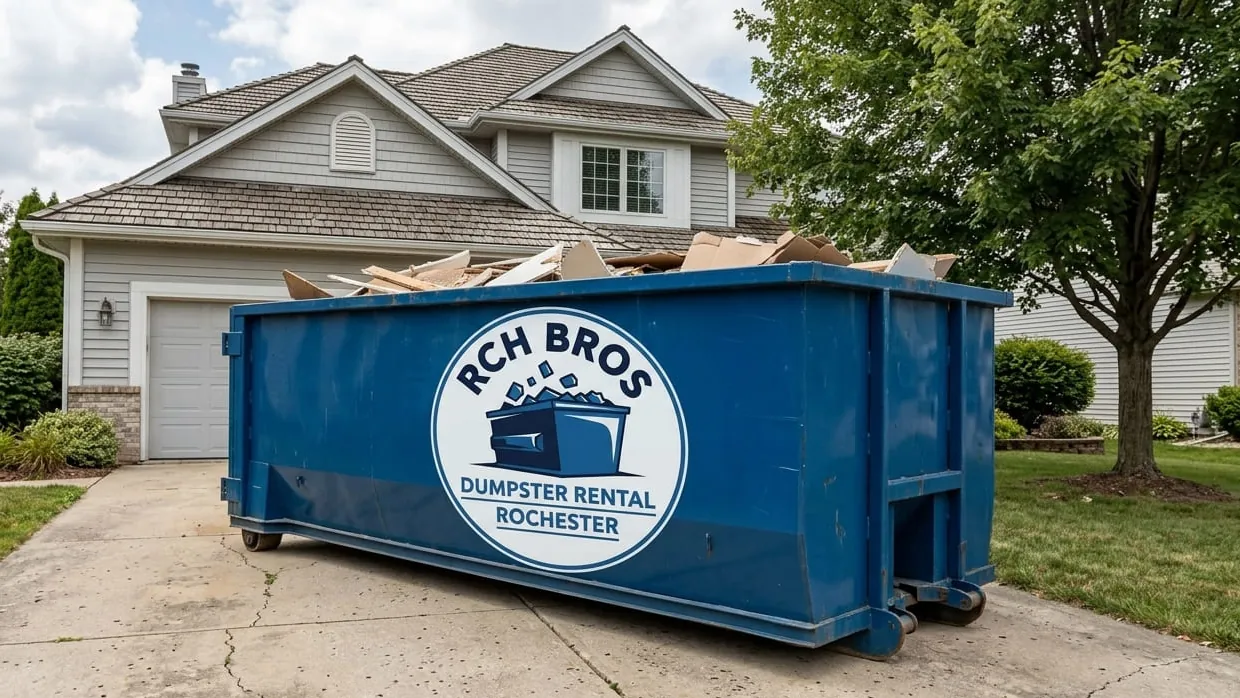
Basements, attics, garages and unit turnovers in a city where more than half the houses were built before 1940. We board the driveway, keep the container five feet off the eave line, and tell you honestly which size the material wants.
A residential job in Rochester almost always starts underground. More than half of this city’s housing units were built in 1939 or earlier, and roughly nine houses in ten predate 1980. Houses of that vintage were built with full excavated basements and floored attics as a matter of course, which is why the phrase “clear out the house” here usually means clear out two levels nobody has properly emptied in forty years. There is no crawl space version of this job and no slab version of it. There is a basement stair, a bulkhead or a hatch, an attic stair behind a door in a back bedroom, and between them somewhere in the region of two floors of stored material that has to come up one armful at a time. Plan the container around the stairs and the door, not around the square footage of the house. That is the single biggest difference between a Rochester house job and the same job written up for a newer part of the country.
The second thing that decides a Rochester house job is what the walls are made of. Pre-1940 construction here means keyed plaster over wood lath, not sheet board, and plaster with the lath still attached is dense, dusty and far heavier than people expect. It is the commonest reason a container goes over payload while it still looks half full. Tile bedded in mortar behaves the same way, and so does a cast-iron tub or a radiator that has been sitting in the basement since the boiler was changed. Our rule on the phone is simple: tell us what the walls are, not how many rooms there are. If the answer is plaster, we will usually put a 10 yard alongside a larger container and split the load by material instead of by room, so neither box carries the other’s problem and neither one reaches a weight nobody can lift.
For most Rochester households the honest answer is the 20 yard. It is the default here because it matches the default job: a basement and an attic emptied over the same two or three weekends, with a garage or a back porch added on at the end. Household contents fill volume faster than they build weight, so a 20 will take a genuinely large clear-out and still leave the driveway usable. A 15 is the right call when the job has a hard edge around it, like one bedroom, one kitchen or one unit of a two-family being turned between tenants. A 30 comes into it when the whole building is being emptied, or when a remodel is running alongside the cleanout. Describe the pile down the phone. We do this every week in Maplewood, the 19th Ward, Irondequoit and Greece, and we would rather size it right the first time than swap a container halfway through your weekend.
Only about 38 per cent of housing units inside the city line are owner-occupied, so a large share of what we call residential work is a landlord turning a unit over. That changes the rules that apply to it. The City has had its own lead ordinance since 2005, under City Code Chapter 90, Article III, and inspection is tied to the certificate of occupancy process. New York’s Lead Rental Registry under Public Health Law § 1377 names Rochester as one of 25 communities of concern. On top of both, the federal EPA renovation, repair and painting rule at 40 CFR Part 745 covers pre-1978 housing, and window replacement and demolition are always covered regardless of square footage. In a city this old, a window job is essentially always an RRP job. That does not change what container you need, but it changes who should be doing the scraping, and it means the debris in the box came off a regulated activity. Our lead-safe renovation debris guide covers how we handle it.
The last thing worth saying out loud is the weather, because it is an operational fact and not a talking point. Rochester averages 102 inches of snow a year, the highest normal of any large metro in the country, and January alone brings about 27 inches across roughly eighteen snow days. Snow in an open container is weight you pay to haul. Keep the tarp on between sessions. In March and April, when frost is coming out of the ground, the silt loams under most Monroe County driveways are at their softest and a loaded 20 yard puts several tons on a small footprint, so we lay plywood under every wheel and under the rails on every driveway placement. If you want the reasoning in full, it is in our driveway protection article, and the winter routing side of it is in winter dumpster rental.
What Rochester Households Actually Clear Out
Full Basement Clear-Out
The volume is at the bottom of the stairs. Shelving, storm windows, canning jars, a decommissioned boiler, the partitioned bay nobody has opened since the last owner, and whatever a wet spring left behind on the floor.
Attic And Knee Walls
Under a cold Rochester roof the contents survive rather than rot, so what comes down the attic stair is intact, heavy and awkward: trunks, boxed paper, bed frames, storm sash and cast-iron radiators pulled years ago and never carried out.
One Unit Of A Two-Family
The up-and-down double is a Rochester staple, and turning one flat between tenants produces carpet, cabinets, a vanity, blinds and the furniture the last tenant left behind. A bounded job, and usually a 15 yard.
Kitchen And Bath Rip-Out
Cabinets, counters, tile set in a mortar bed, a cast-iron tub and the plaster behind all of it. The tub and the copper come out for scrap before the container goes on the truck.
Plaster And Lath Strip-Out
Taking a pre-1940 room back to the studs makes the heaviest debris in residential work. Load it flat on the floor of the container, spread across the whole floor rather than heaped at the door end.
Water In The Basement
A failed sump, a burst supply line or an ice dam that backed water down an interior wall. Sodden carpet, saturated cardboard and swollen furniture weigh two to three times what they look like.
Garage, Porch And Fence Line
Detached garages behind the house, a rotted rear porch, collapsed fencing and an old shed. Treated timber, roofing off the garage and the odd concrete step, which wants loading flat.
Furniture And Appliances
The bulk a household accumulates. Electronics come out of the load entirely, because New York banned them from the trash on 1 January 2015, and they go to the Monroe County ecopark instead.
Sizing A Container For A Rochester House
Start with the material, not the room count. A 10 yard is the weight container: masonry, tile in a mortar bed, plaster and lath out of a pre-1940 wall, rubble foundation spoil, or the contents of a basement that took water. It reaches payload long before it looks full, and that is the box working correctly. A 15 yard covers one bounded job — a kitchen, a bath, a bedroom stripped, a garage emptied, or one unit of a two-family turned over. A 20 yard is the Rochester default, because a full basement and attic clear-out is the Rochester default job. A 30 yard is for a whole two-family emptied top to bottom, or a large remodel running alongside a cleanout. A 40 yard is airy bulk only: furniture, cabinetry, framing, siding. Never masonry and never wet basement contents. Full dimensions and payload notes are on the container sizes page, and if you would rather just describe the pile, call the yard and we will tell you which one the material wants.
10 Yard Dumpster
Concrete, brick, plaster and lath and rubble foundation spoil — weight fills it long before volume does.
View this size →15yd³15 Yard Dumpster
A single room, a small tear-off, or one unit of a two-family turnover.
View this size →20yd³20 Yard Dumpster
A full basement and attic clear-out — the Rochester default — or a multi-room remodel.
View this size →Driveways, Snow And The Five-Foot Rule
A Rochester driveway is usually narrow, usually older than the car on it, and usually running past a tree lawn with a mature canopy over it. The truck wants roughly 60 feet of straight approach, about ten and a half feet of width, and 20 feet or more of overhead clearance for the hoist. Overhead is what stops a set here far more often than the ground: the street canopy arches over the drive and the electrical service drop runs beneath it from the pole to the house. Look up before you book. Plywood goes under every wheel and under the rails on every driveway placement, and we photograph the approach on arrival, because freeze-thaw has already worked on most concrete and asphalt in this county. On placement, the Fire Code of New York State, adopted at 19 NYCRR Part 1225, carries the International Fire Code rule that a container over the size threshold may not sit inside a building or within five feet of combustible walls, openings or combustible roof eave lines. The threshold itself tightened in the 2025 code cycle, so check with your local code enforcement officer. We place every container at least five feet off the siding, the soffit line and any door or window. If the only spot is the street, that is a written right-of-way permit from the City Engineer under City Code § 104-24, and § 104-24(C) requires the obstruction to be barricaded and lit at night.
Not sure this is the right service? Describe the job on the phone and we will point you at the right container even if it is a different service page. Call (585) 514-5622.
Get a flat quote
Two minutes on the phone gets you a size, a price and a delivery slot. No forms.
(585) 514-5622Recommended sizes
How it works
Residential Dumpster Rental in four steps
- 1
Call us
Tell us the project, your address and when you want it. Two minutes on the phone and you have a flat price.
- 2
We deliver
Our driver walks the drop, lays protection boards and sets the container exactly where you want it.
- 3
You load it
Take your time within your rental window. Keep it level with the top rail and we handle the rest.
- 4
We haul it
Call or text when you are done. We pull it, sort what can be recovered and dispose of the rest properly.
Residential Dumpster Rental FAQs
I rent one side of a two-family. Can I book a container myself?
Yes, tenants do it here regularly, but the driveway is not yours and the owner needs to know before the truck arrives. The container has to sit on private ground with the owner’s consent, or in the street under a right-of-way permit from the City Engineer under City Code § 104-24. Before you book, check what is already covered for nothing. The Monroe County ecopark at 10 Avion Drive takes electronics, appliances, scrap metal, fluorescent lights, rechargeable batteries and textiles on a walk-in basis, and household hazardous waste by appointment, for Monroe County residents only. If the job is a whole flat cleared front to back, or anything with renovation debris in it, that is container work and the ecopark is not the answer.
Why does every Rochester house job turn into a basement job?
Because nearly every house here has a full one. This is old northern building stock: footings go below whatever depth the local jurisdiction sets, and once the hole is that deep a full basement costs very little more than a shallow one, so builders here put one under almost everything for well over a century. Add attics that are floored and dry, and you get two levels of storage that three or four generations have filled. Plan for the stairs rather than the floor plan. A thirty-foot run with a turn in it sets the pace of the entire day, and it is worth having the container parked as close to the door as the five-foot rule allows.
What cannot go in the container?
Asbestos in any form, ever. Asbestos in New York moves under a separate NYSDEC Part 364 permit and has to be handled by a contractor licensed by the New York State Department of Labor under 12 NYCRR Part 56. Beyond that, keep out anything with its own state program already paying for it. Electronics have been banned from the trash since 1 January 2015 under ECL Article 27, Title 26. Rechargeable batteries are illegal in the trash under Title 18, and the 2025 amendment added e-bike and e-scooter batteries. Leftover paint goes free to a PaintCare drop-off, a New York program since May 2022. Liquids, fuel, tires and pressurised cylinders stay out.
Can I take two or three weekends to fill it?
Take the time the job honestly needs. Most basement and attic clear-outs here run across two or three weekends, because the material comes up a stair one load at a time, and a container on your own driveway is the cheapest debris storage you will ever have. Call the yard when you want it collected and we will fit it into the route rather than hold you to a fixed day. Two things are worth watching. Keep it tarped, because rain and snow both turn into payload, and 102 inches of snow a year means a container in a Rochester driveway in January gets snowed on roughly every other day. And load the heavy material flat on the floor rather than heaping it at the door end.
Does the City take any of this?
Some of it, and it is worth knowing exactly where the line falls. The City provides one City-issued container for refuse storage under City Code § 20-12A, stored at the rear or side yard under § 20-14 and set out no earlier than the night before collection under § 20-15B. What that system is not built for is renovation debris. City Code § 20-15F says it plainly: contractors performing work must make their own arrangements for lawful collection and disposal, and that waste shall not be collected by the City. The county landfill is no help to a homeowner either, since Mill Seat in Riga is commercial accounts only. That gap is exactly why roll-off service exists here. See the City of Rochester for current refuse rules.
More services
Other things we haul
Commercial Dumpster Rental
Containers for businesses and contractors — City Code §20-15F puts construction waste on you, not the City.
Learn more →Construction Dumpster Rental
Mixed C&D in one roll-off, with next-day swap-outs across Monroe County.
Learn more →Roofing Dumpster Rental
Weight-rated cans sized by squares and layers, set five feet off the eave line.
Learn more →Roll-Off Dumpster Rental
10, 15, 20, 30 and 40 yard roll-offs across Rochester and Monroe County.
Learn more →Same-Day Dumpster Rental
Call before the cut-off and we can usually get a container to you this afternoon.
Learn more →Junk Removal Dumpsters
Clear a full basement, attic, porch or garage on your own schedule.
Learn more →Estate Cleanout Dumpsters
Discreet, patient container service for families clearing a lifelong home.
Learn more →Demolition Debris Removal
Containers and fast swaps for porches, decks, sheds, garages and interior gut-outs.
Learn more →Concrete & Heavy Debris
Dedicated heavy cans for concrete, brick, plaster and rubble foundation spoil.
Learn more →Yard Waste & Brush Removal
Separate clean loads — the City picks up leaves, not your deck or your shingles.
Learn more →Where we deliver
Residential Dumpster Rental across Monroe County and Greater Rochester
Same service, same flat rates, every town below. Pick yours for local placement and permit notes.
Talk to a real person
Need residential dumpster rental in Rochester?
Tell us what you are clearing out and we will tell you the right size and the flat price to put it in your driveway. No forms, no waiting on an email — just call and we will sort it out in a couple of minutes.
Serving Rochester, Monroe County and Greater Rochester · Mon–Fri 6:30am–5pm, Sat 7am–1pm