
Gates, NY · Monroe County
Dumpster Rental in Gates, NY
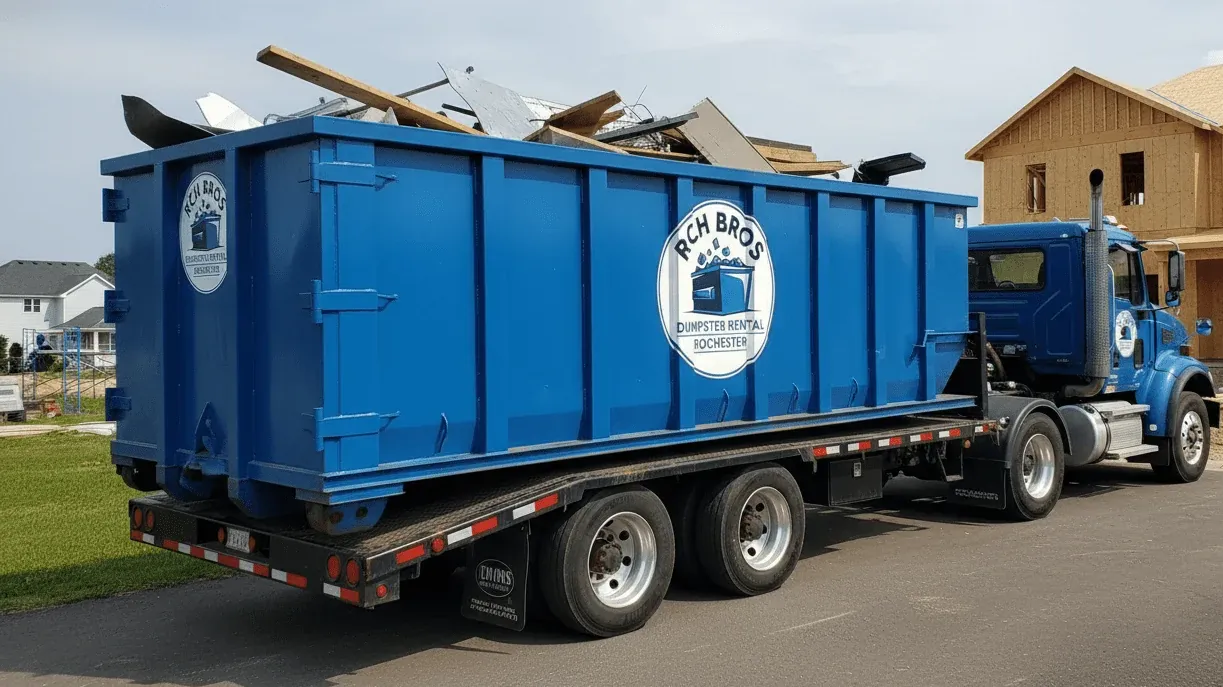
Roll-off containers delivered to Gates from our Rochester yard — a little over a mile west of our Hague Street yard — our own side of town. Flat rates, driveway protection as standard, and same-day delivery when we can get a truck free.
Roll-off containers for Gates homes and jobsites
Gates is our own side of town. The yard on Hague Street sits on the west side of Rochester, close enough to the Gates line that a delivery here is measured in minutes rather than miles, and it is the shortest run we make. With 29,167 people, Gates is a mid-sized Monroe County town that sits directly west of the city, and for a lot of purposes it functions as the western extension of the same neighborhood pattern — the streets nearest the line were built at the same time and in the same way as the city streets they continue.
The housing is mostly post-war with an older band along the city edge. Ranches, capes, split-levels and colonials from the late 1940s through the 1970s, plus a good deal of 1980s and later building further out, and a scattering of pre-war houses on the older roads. Full basements throughout, attached garages on most of it, and driveways that are generally wide enough and long enough to take a container without a negotiation. That last point sounds minor and is not. In the city we spend a lot of time working out where a box can legally go. In Gates the driveway almost always answers the question, which makes the job faster and cheaper for everyone.
What we carry out of Gates is a steady mix. Roofing is constant, because the post-war stock is at the age where second and third replacements happen. Basement finishing and refinishing is constant for the same reason. Garage and shed clear-outs, deck tear-outs, kitchen and bath remodels, and a solid volume of estate work as the original owners of the 1950s and 1960s houses move on. There is light industrial and commercial work along Buffalo Road, Lyell Avenue and out toward the airport, and the Monroe County ecopark sits at 10 Avion Drive in this corner of the county, which makes it genuinely convenient for the things a container cannot take.
Being this close changes what we can promise. Same-day is realistic here more often than anywhere else on our list — call before nine and we can usually make it. A swap on a busy job can happen the same afternoon rather than the next morning. And in winter, when 102.0 inches of snow a year turns routing into the whole problem, being a mile away means we are still coming. Gates is a town, so the Town’s building department answers the permit questions and the City of Rochester’s codes do not apply out here, including the § 104-24 right-of-way permit that governs a street placement inside the city. On this side of the line the driveway is the answer anyway, and protecting that driveway is the part of the job we actually spend time on. Access on this side of town is about as good as it gets in Monroe County, but there are still two things we ask about. The first is whether the container will block the garage door or a side entrance for the duration, because on a postwar Gates lot the driveway is often the only route to both. The second is the age and condition of the asphalt. A lot of these driveways are original to the house or close to it, and an old surface with alligator cracking will take a mark under several tons whatever we put down. We would rather tell you that before delivery than have the conversation afterwards. If the surface is genuinely fragile, we will look at the verge or the apron instead.
What we know about working in Gates
Gates jobs nearly always end up on a driveway, so driveway protection is where the care goes. A loaded 20-yard container puts several tons on a small footprint. Monroe County’s dominant soils are silt loams — Collamer, moderately well drained, and Niagara, somewhat poorly drained and in hydrologic group C and D — with Honeoye the region’s signature series, a loamy till soil that sits on the till plains and drumlins across western New York. In March and April, when frost is coming out of the ground here, asphalt over those soils is at its softest, and that is when a container leaves marks. We lay plywood under every wheel and under the rails on every driveway placement, we keep the truck straight rather than turning under load, and on a sloped drive we chock. If your driveway is new asphalt, tell us on the phone: fresh asphalt cures slowly and we will either wait or set the box on the street verge with your agreement instead. The seasonal picture matters too. New York does not run a statewide frost law, but under Vehicle and Traffic Law § 1660(a)(11) a town board can temporarily exclude vehicles of four or more tons from any portion of a town highway when it believes the highway would be materially injured — and a 1980 Attorney General opinion confirms this is most frequently applied during the spring thaw. The restriction takes effect on the erection of signs and lasts until the board directs their removal. There is a carve-out: the statute is not to be construed to prevent the delivery or pickup of merchandise or other property along the excluded highways, and operators can request permits for essential local pickup or delivery where a denial would create hardship. Practically, it means a March delivery in a Monroe County town sometimes gets scheduled differently from the same delivery in July, and we will tell you if that applies. Most Monroe County towns also restrict overnight on-street parking through the winter, with the months and hours varying town by town — one more reason the driveway wins. Before you dig for a footing, a post or a drain run, call UDig NY, which needs at least two but not more than 10 working days. Five feet of clearance from combustible walls, openings and eave lines, always. The ecopark at 10 Avion Drive is right here for what the container cannot take — appointment for hazardous waste, walk-in for electronics, Monroe County residents only. See how we protect a driveway on delivery.
- RegionMonroe County
- Distance from our yardA little over a mile west of our Hague Street yard — our own side of town
- Main routesBuffalo Road west straight out of the yard, which is the shortest run we make
- Typical deliverySame or next day
Getting a truck to you
Buffalo Road west out of the yard is the whole trip for most of Gates and it takes a matter of minutes. Lyell Avenue west covers the northern half, Chili Avenue west serves the southern streets and the airport side, and NY-531 carries us out to the Spencerport Road end and the far edge of the town. I-490 west is there when Buffalo Road is busy at shift change. Because this is our home ground, same-day delivery is realistic more often than not, and a same-day swap on a running job is usually possible if you call by mid-morning. At booking we want the address, the driveway width, length and surface, whether it is asphalt and how new, the slope, what is overhead, and whether the container will block a garage door or a side entrance. Then the load itself — a roof tear-off, a basement finish, a garage clear-out and a whole-house estate job are four different sizes, and roofing in particular is sized by squares and layers rather than by rooms.
Routes we run: Buffalo Road west straight out of the yard, which is the shortest run we make, Lyell Avenue west across the town line for the northern half, NY-531 west for anything toward the Spencerport Road end and the far side of town, Chili Avenue west for the southern streets and the airport side, I-490 west one short stretch when Buffalo Road is busy.
Landmarks and neighborhoods we work around
Local landmarks
- the Buffalo Road corridor
- Lyell Avenue running west out of the city
- the NY-531 expressway across the north of the town
- the Monroe County ecopark at 10 Avion Drive
- the Chili Avenue and airport approach
- the Spencerport Road corridor
Neighborhoods & communities
- North Gates
- Westgate
- the Buffalo Road corridor
- the Hinchey Road area
- the Spencerport Road corridor
- Elmgrove
Permits, streets and placement in Gates
On a private driveway in Gates the placement question is mostly not a permit question at all, and that surprises people. A container that sits entirely on your own driveway or private property is generally outside the City of Rochester’s right-of-way permit requirement at City Code § 104-24, and the towns around the city take the same broad view of private ground. The moment any part of the box, or the room the truck needs to set it down, touches the sidewalk, the tree lawn or the street, the answer changes. Inside the city line that means a written right-of-way permit from the City Engineer. § 104-24(A) puts it plainly: no person shall “place or suffer to remain materials of any kind or any goods, wares, merchandise, equipment, machinery or other article or obstruction in the right-of-way without a permit in writing from the City Engineer, except while in the process of actively loading or unloading.” Read the rest of that section before you plan a street placement, because § 104-24(C) requires the obstruction to be barricaded and lit at night, the City Engineer sets the conditions and the timeframe, a permit can be revoked without notice under § 104-24(B), and everything has to be off the right-of-way by the time it expires under § 104-24(D). On a Rochester street in December the sun is down before five o’clock, so we put reflective marking on every street placement as a matter of course. Current fees and the application process come from the Department of Environmental Services rather than from any web page, ours included. Outside the city the same call goes to the town’s own public works or engineering office, because street rules follow the address. Winter tightens all of it: the City limits any vehicle to twelve hours in one spot under § 111-16 and can prohibit parking along designated snow routes by declaration under § 111-73, and most Monroe County towns ban overnight on-street parking through the winter, with the months and the hours differing town by town. A container in the street is governed separately from all of that, by the § 104-24 permit, but the simplest answer in Gates is nearly always the driveway. The driveway has a rule of its own, and it is a fire rule. New York’s fire code is the Fire Code of New York State, adopted at 19 NYCRR Part 1225, and it carries the International Fire Code requirement that a container over the size threshold not be placed inside a building or within five feet of combustible walls, openings or combustible roof eave lines. Five feet is the stable number and we work to it. The capacity threshold itself tightened in the 2025 code cycle, so if the only workable spot is tight against the building, check with your local code enforcement officer before we deliver. We keep every container five feet off the siding, the soffit line and any door or window, clear of exits, fire-apparatus access and hydrants, and no flammable or combustible liquids go in it. There is no statewide per-dumpster fire permit in New York, and Rochester does not appear to require a fire-department permit for a temporary container; what it does require, for a street placement, is the right-of-way permit above. When you pick the spot, look up as well as around. Rochester’s mature street canopy has the electrical service drop running underneath it, and a spot that is wide open at eye level can be closed at twenty feet.
Two more rules reach every job we run, and both come from the state rather than the town. The first is asbestos, and New York files it somewhere people do not expect: the rule is 12 NYCRR Part 56, Industrial Code Rule 56, enforced by the New York State Department of Labor — an industrial code rule, not an environmental regulation. § 56-5.1 requires an asbestos survey before demolition, renovation, remodeling or repair. The carve-out is narrow and it gets misread constantly: it covers “the owner of one and two-family dwellings who contracts for, but does not direct or control the work.” That is not the same thing as houses being exempt. The survey exemptions — agricultural buildings, structures whose original construction commenced after 1 January 1974, and buildings certified structurally unsound by a licensed engineer, architect or building inspector — carry a sting as well, because NYSDOL says a building that qualifies for one must still be assumed to contain asbestos and demolished as an asbestos project unless a survey documents that there is none. An exemption from the survey is a presumption of asbestos, and that costs more than the survey would have. Most of the stock in and around Gates went up long before 1974, and 9 by 9 vinyl floor tile and wrapped pipe insulation in the basement are ordinary here rather than exotic. We cannot take asbestos-containing material in any container. Asbestos in New York moves under a separate NYSDEC Part 364 permit and has to be handled by a NYSDOL-licensed asbestos contractor. The second rule is lead, and around here it is the default condition of the job rather than an edge case. Anything built before 1978 falls under the EPA RRP rule at 40 CFR Part 745, and window replacement and demolition are covered regardless of square footage, so a window job in Gates is essentially always an RRP job. The City of Rochester has run its own lead ordinance since 2006 at Municipal Code Ch. 90, Art. III, tied directly to the certificate of occupancy, and the New York State Lead Rental Registry under Public Health Law § 1377 reaches rental property with two or more units built before 1980, with Rochester named among the state’s communities of concern. Paint scrapings, old window units and plaster off a pre-1980 rental are the debris of a regulated activity, and we would rather know that before the truck rolls than after. Before anything is dug, trenched, driven or a stump pulled, call UDig NY on 811. The notice window under 16 NYCRR § 753-3.1 is at least two but not more than 10 working days, so that call goes in the week before, not the morning of. Our permit and placement guide walks through the whole process, and refuse, recycling and right-of-way details are published by the City of Rochester.
The ground is the other local variable, and in New York it is not the tidy number people expect. New York publishes no statewide frost depth. Table R301.2(1) of the Residential Code of New York State, at 19 NYCRR Part 1220, leaves that cell for the municipality to fill in, and the State’s own guidance says “the local jurisdiction shall provide the minimum depth of footing below finish grade.” So the footing depth for a job in Gates is a question for the building department that covers you, not something you read off a national chart. What is not in doubt is the climate: the ground here really freezes, footings go well below grade, and that is why full basements are near-universal in this housing stock. A cleanout in Gates therefore starts a floor lower than a sizing guide written for the south would assume. The basement and the attic are the job, and what comes up those stairs is storm windows, paint tins, a workbench, furniture and thirty years of boxes. The housing itself is the second half of that. 53.7 percent of Rochester’s housing was built in 1939 or earlier, roughly nine houses in ten predate 1980, and this metro ranks eighth-oldest among large US metros. In the container that reads as stone and rubble foundations, balloon framing, plaster and wood lath instead of drywall, knob-and-tube wiring and cast-iron drain lines. Plaster and lath is dense, and it is the single commonest reason a container goes over payload while it still looks half full, which is why we would rather send a 10 yard twice than a 30 yard once on a gut job. Only 38.1 percent of city housing is owner-occupied, so inside the city line the typical residential job is a landlord turnover on a two-family up-and-down rather than a homeowner remodel, while out in the county towns it is more often a roof, a remodel or a landscape clear-out on a two-story detached house. Then there is the weather, which is the part of this market nobody else has to write about. 102.0 inches of snow is the 1991–2020 normal published by the National Weather Service in Buffalo, higher than any other US metro over a million people. January alone brings 27.4 inches across 17.6 snow days. The gradient inside the county is real: roughly 70 inches south of the city, about 90 in the city itself and over 120 along the lakeshore east of it, with about half of the annual total falling as ordinary storm snow and the rest as lake effect off Lake Ontario. Snow sitting in an open container is weight you pay to haul, so tarp it or lid it between loads. Access moves with the season too: snowbanks and the plow windrow narrow a drive that took a 30 yard in October, and on gravel or a shared drive we would rather move you a day than leave ruts through soft ground. Spring is the other pinch. Monroe County’s dominant soils are silt loams — Collamer and Niagara, with Honeoye the region’s signature series — wet in spring and soft under load. And New York runs no statewide frost law. Under Vehicle and Traffic Law § 1660(a)(11) each town board may “temporarily exclude from any portion of any town highway any vehicle with a gross weight of over four or more tons” when the thaw makes the road soft; the restriction “take[s] effect upon the erection of signs”; and the statute provides that such exclusions “shall not be construed to prevent the delivery or pickup of merchandise or other property.” So a March delivery in a Monroe County town is sometimes scheduled differently from the same delivery in July, and we watch for the signs rather than guess. Plywood goes under every wheel and under the rails, on every driveway placement, all year. Where the load ends up is the part people assume and get wrong, and here the answer sits unusually close to home. Monroe County owns Mill Seat Landfill, in the Town of Riga on the west side of the county; Waste Management operates it under a 49-year lease signed in 2002, its approved capacity is 1,945 tons a day and its permitted life runs through 2057. High Acres Landfill, run by Waste Management of New York, sits at the eastern edge of the county in Perinton. Disposal capacity for this market is inside the county line, which is not true of every Northeast city. But Mill Seat is “COMMERCIAL ACCOUNTS ONLY. NO RESIDENTIAL CUSTOMERS,” open Monday to Friday, 7:00 a.m. to 3:30 p.m. A homeowner in Gates cannot drive a pickup there, and that is precisely why roll-off service exists in this county. Household quantities take a different route entirely. Those go to the Monroe County ecopark, 10 Avion Drive, Rochester NY 14624 — Wednesday 1:00 to 6:30 p.m. and Saturday 7:30 a.m. to 1:00 p.m., with an appointment required for household hazardous waste and walk-in service for electronics, appliances, pharmaceuticals, sharps, fluorescent lights, scrap metal, propane tanks, rechargeable batteries and textiles. Some items are fee-based and it is credit or debit only, and the ecopark is “for use by Monroe County residents only,” which covers everyone we deliver to. Paint, solvents, automotive fluids, batteries and pool chemicals never ride in one of our containers. That county layer is the thing to understand about working here. Monroe County is the working unit: it owns the landfill, runs the recycling center, runs the ecopark and runs the childhood lead program, and none of that stops at the city line. What does change at the town line is the street — the City wants that written right-of-way permit from the City Engineer, barricaded and lit after dark, while each town around it runs its own arrangements and its own seasonal overnight parking ban on dates and hours of its own choosing. That is one more argument for the driveway. Last, what has to come out of the load. New York has no waste-ban list; the phrase gets repeated on dumpster pages and it does not exist. What the state did instead was General Municipal Law § 120-aa, which ordered every municipality to adopt its own source-separation law by 1 September 1992 — Rochester complied with City Code Ch. 20, Art. IV, adopted 19 November 1991. The real bans are product by product, each in its own Title of ECL Article 27: electronics under Title 26 since 1 January 2015, rechargeable batteries under Title 18, waste tires under Title 19, and mercury thermostats under Title 29 since 2005 — and on that last one NYSDEC names contractors “demolishing buildings” specifically. Leftover paint has had PaintCare in New York since May 2022 under Title 20, so it goes to a drop-off site rather than into the box. And the City states the rest of it outright at § 20-15F: “Contractors performing work must make arrangements for the proper and legal collection and disposal of waste generated during the construction process and such waste shall not be collected by the City.” That sentence is the line where a roll-off starts.
Sizes we deliver to Gates
10 Yard Dumpster
Concrete, brick, plaster and lath and rubble foundation spoil — weight fills it long before volume does.
View this size → 15yd³15 Yard Dumpster
A single room, a small tear-off, or one unit of a two-family turnover.
View this size → 20yd³20 Yard Dumpster
A full basement and attic clear-out — the Rochester default — or a multi-room remodel.
View this size → 30yd³30 Yard Dumpster
A whole two-family turnover with basement and attic, or a large remodel.
View this size → 40yd³40 Yard Dumpster
Whole-house cleanouts, commercial gut jobs and redevelopment debris.
View this size →Delivering to Gates today
Call before about 11am and we can usually get a container to Gates the same afternoon.
(585) 514-5622Popular in Gates
Services in Gates
What we haul in and out of Gates
Roofing Dumpster Rental
Weight-rated cans sized by squares and layers, set five feet off the eave line.
Learn more →Residential Dumpster Rental
Driveway placement for the full-basement, attic and porch cleanouts a pre-1940 house produces.
Learn more →Demolition Debris Removal
Containers and fast swaps for porches, decks, sheds, garages and interior gut-outs.
Learn more →Junk Removal Dumpsters
Clear a full basement, attic, porch or garage on your own schedule.
Learn more →Construction Dumpster Rental
Mixed C&D in one roll-off, with next-day swap-outs across Monroe County.
Learn more →Commercial Dumpster Rental
Containers for businesses and contractors — City Code §20-15F puts construction waste on you, not the City.
Learn more →How it works
Delivering to Gates in four steps
- 1
Call us
Tell us the project, your address and when you want it. Two minutes on the phone and you have a flat price.
- 2
We deliver
Our driver walks the drop, lays protection boards and sets the container exactly where you want it.
- 3
You load it
Take your time within your rental window. Keep it level with the top rail and we handle the rest.
- 4
We haul it
Call or text when you are done. We pull it, sort what can be recovered and dispose of the rest properly.
Dumpster Rental in Gates — FAQs
How fast can you get a container to a Gates address?
Faster than anywhere else we serve. The yard is at 595 Hague St on the west side of Rochester, a little over a mile from the Gates line, and Buffalo Road west is the whole trip for most of the town. Call before nine and same-day is usually realistic. A swap on a busy job can happen the same afternoon rather than the next morning, which matters when a crew is standing around a full box. Lyell Avenue covers the northern half, Chili Avenue serves the southern streets and the airport side, and NY-531 runs out to the Spencerport Road end. In winter, being a mile away means we are still coming.
Will a loaded container mark my Gates driveway?
Not if we set it up properly, and this is where the care goes on a Gates job. A loaded 20 yard container puts several tons on a small footprint. Monroe County’s soils are silt loams — Collamer, moderately well drained, and Niagara, somewhat poorly drained — with Honeoye the region’s signature series, and in March and April, when frost is coming out of the ground, asphalt over those soils is at its softest. We lay plywood under every wheel and under the rails, keep the truck straight rather than turning under load, and chock on a slope. If the asphalt is original to the house and alligator cracked, or if it is new, tell us on the phone.
Is the Monroe County ecopark really here in Gates?
It is, at 10 Avion Drive, Rochester NY 14624, in this corner of the county, which makes it genuinely convenient for the things a container cannot take. It opens Wednesday 1:00 to 6:30 p.m. and Saturday 7:30 a.m. to 1:00 p.m. An appointment is required for household hazardous waste. Electronics, appliances, pharmaceuticals, sharps, fluorescent lights, scrap metal, propane tanks, rechargeable batteries, paper and cardboard, plastics, textiles and document shredding are all walk-in. It is for use by Monroe County residents only, and the fee items are credit or debit card. Paint, solvents, automotive fluids and pool chemicals go there rather than into one of our boxes.
Does a Gates job need a City of Rochester street permit?
No. Gates is a town, the Town’s building department answers the permit questions, and the City of Rochester’s codes do not reach out here — including the § 104-24 right-of-way permit that governs a street placement inside the city. On this side of the line the driveway is nearly always the right answer anyway, because the post-war lots have driveways wide and long enough to take a container without a negotiation. In the city we spend real time working out where a box can legally go. In Gates the driveway usually settles it, which makes the job faster and cheaper for everybody. Most Monroe County towns restrict overnight on-street parking through the winter as well.
Can you still deliver in Gates during the March thaw?
Nearly always, and where there is a complication we will tell you. New York runs no statewide frost law. What it has instead is Vehicle and Traffic Law § 1660(a)(11), under which a town board can temporarily exclude vehicles of four or more tons from portions of a town highway when it believes the road would be materially injured. A 1980 Attorney General informal opinion confirms it is applied most often during the spring thaw. It takes effect on the erection of signs and lasts until the board directs their removal, and the statute carves out delivery and pickup of merchandise or other property. So a March delivery is sometimes scheduled differently from the same one in July.
How quickly can you deliver a dumpster to Gates?
Gates is a little over a mile west of our Hague Street yard — our own side of town, so it is a routine run for us. Same-day delivery is usually possible if you call before about 11am, and next morning otherwise. A heavy lake-effect week or a hard wind event can stretch that, and so can the spring thaw, when half the county opens a wet basement at once. We will tell you honestly when you call.
Do you charge extra to deliver to Gates?
No. Gates sits inside our standard service area and the flat rate is the same as it is in Rochester. Delivery, pickup, your rental window and disposal up to the agreed tonnage are all included in the number we quote you.
What size dumpster do most Gates customers take?
A 20 yard is the most common by a wide margin — it suits kitchen guts, multi-room renovations and a full basement and attic clear-out in a two-family, which is where most of the volume in this market actually lives. But if you are stripping shingle off a roof, breaking out a front walk, a patio slab or a cellar floor, or hauling rubble foundation and footing spoil off a repair job, size DOWN to a 10 yard heavy container and take two hauls — that material hits the weight limit long before it fills the box.
Nearby
Towns we serve around Gates
Talk to a real person
Need a dumpster in Gates?
Tell us the job and the address and we will size it, price it flat and get a truck out. We run to Gates most days, so a same-day slot is often available.
Gates, NY · Monroe County · delivered from 595 Hague St, Rochester, NY 14606