
Seasonal
Winter Dumpster Rental in Rochester: 102 Inches of Math
Winter does not stop work in Rochester, it changes the arithmetic. Snow is weight you pay to haul, and the driveway beats the street from November through April.
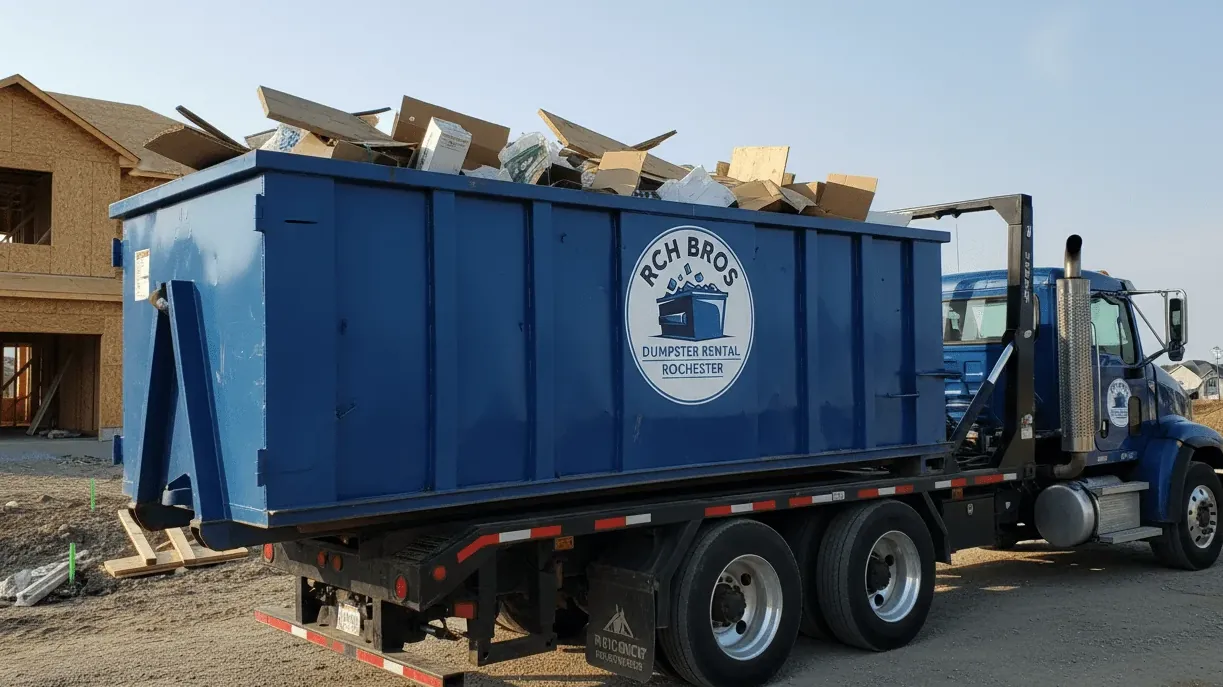
Winter does not stop work here. It changes the arithmetic. A container that behaves one way in September behaves differently in January, and most of the difference comes down to a single fact: snow is weight, and weight is what you pay to haul.
We have been running cans through Rochester winters since 2011. This is what actually matters, in the order it matters.
102 inches is the normal, not the record
Rochester’s 1991 to 2020 normal annual snowfall is 102.0 inches, published by the National Weather Service office that covers western New York. That is the average season, not a bad one. The previous 1981 to 2010 normal was 99.5 inches, so the figure went up.
The month that does the damage is January: 27.4 inches over 17.6 snow days. February runs 23.1 inches, December 22.3, March 17.9. Put those together and you get the operational reality: a container sitting open in your driveway in January is being snowed on roughly every other day.
The other thing to know is that the county is not uniform. Seasonal totals run roughly 70 inches south of the city, about 90 inches in the city itself, and over 120 inches along the lakeshore east of it. Roughly 50 inches of that comes from general storms; the rest is lake effect off Lake Ontario, which is why a band can bury Webster while Rush and Mendon see flurries. That gradient is a scheduling fact, not trivia. A delivery day on the lakeshore is not the same as a delivery day on the south side of the county. You can see where we run across the whole spread.
Snow in an open container is weight you pay to haul
This is the single most expensive winter mistake, and it is entirely avoidable.
An open roll-off is a shallow rectangular pan with a large footprint. Every storm drops into it. That snow melts partway, refreezes, packs down into the debris and takes on more water from the next event. By the time we pick up, a container that was loaded to a reasonable line in December can be carrying a meaningful amount of material that has nothing to do with your project.
It counts against the same payload limit your debris counts against. Two consequences follow: it can push a load over the legal limit, and it shows up as weight on the ticket.
Tarp it or lid it
The fix costs almost nothing. Cover the container between working sessions and keep the cover on when the job pauses. A tarp strapped down at four corners is enough. It keeps snow out, it keeps rain out, and it keeps the neighborhood’s furniture out, which is a separate problem on a city street.
What packs down worst
- Cardboard and paper. Absorbs everything, weighs several times its dry weight.
- Insulation. Same problem, more volume.
- Carpet and padding. Already heavy dry. Wet it is punishing.
- Plaster and lath. Dense to begin with, and it drinks water.
- Drywall. Turns to mush and adds weight without adding usable volume.
Load those materials early in the rental window and get them off site. We go through the rest of the cost drivers in what drives dumpster cost in Rochester.
Put it on the driveway, and bring plywood
Winter placement is a driveway conversation nine times out of ten, for reasons that have nothing to do with snow removal.
A loaded 20 yard container puts several tons on a small footprint. In March and April, when frost is coming out of the ground here, asphalt driveways over Monroe County’s silt loams are at their softest. The dominant local soils are silt loams, moderately to somewhat poorly drained, exactly the kind that hold water and go soft when they thaw. We lay plywood under every wheel and under the rails on every driveway placement. It spreads the load and it keeps steel off asphalt.
A few other winter placement habits:
- Clear the placement before we arrive. We need to see the surface we are setting on, and so do you.
- Leave a straight approach. A roll-off is delivered by rolling the box off a tilted bed. Ice on a slope is the enemy of that.
- Think about where the plow throws. Do not park a container where the plow banks the drive shut.
- Keep the doors accessible. A barn-door end frozen into a snowbank is a bad morning.
- Mark it. A dark box in a white driveway at 4:45 pm in December is genuinely hard to see.
Snow emergencies and street placements
If the container has to go in the street, winter adds two layers.
First, the permit. A container placed entirely on your own driveway or private property is generally outside the City’s right-of-way permit requirement under City Code § 104-24. If any part of it touches the sidewalk, the tree lawn or the street, you need a written permit from the City Engineer. And § 104-24(C) requires the obstruction to be barricaded and lit at night. On a Rochester street in December, sunset is before five o’clock, so that requirement covers most of your rental period. We put reflective marking on every street placement.
Second, snow emergencies. Under City Code § 111-73(A), when the Commissioner of Environmental Services advises that plowing will be prevented by parked vehicles, the Mayor may declare an emergency and parking may be prohibited along designated snow routes. The declaration is publicized by an announcement over not less than two radio or television stations. If one lands mid-job on a street placement, call us. It is a lot easier to move a container early than to sort it out afterward. The City of Rochester is the place to watch for the declaration itself.
Keep the three rule sets separate in your head. The City limits any vehicle to 12 hours in one spot under § 111-16, and can prohibit snow-route parking by declaration under § 111-73. A container in the street is governed separately, by the right-of-way obstruction permit at § 104-24, which the City Engineer issues with its own conditions and time limit.
Out in the towns, the street may simply be closed to you
Most Monroe County towns ban overnight on-street parking through the winter. The months and the hours vary town by town, and the only reliable source for your address is your own town. Check before you assume a street placement is available in January.
That is one more reason we put your container on the driveway, not the street, and why we bring plywood. Suburban lots in Greece, Penfield, Webster, Pittsford, Chili and Gates usually have the room, which makes the whole question go away.
The ground freezes here, and nobody publishes a number for it
People ask us for the frost depth in Rochester, usually because they read a figure on a national calculator site. Here is the honest answer.
New York does not print a statewide frost depth. Table R301.2(1) of the Residential Code of New York State leaves that blank for each municipality to fill in, and the State’s own guidance says the local jurisdiction shall provide the minimum depth of footing below finish grade. Jurisdictions weigh air freezing index, soil type, water table depth, local historical data and field experience in setting it. So the number for your footings is a question for your town’s building department, not something you read off a national chart. The New York Department of State administers the Uniform Code that table sits in.
What we can tell you from the seat of a truck is that the ground here genuinely freezes and genuinely thaws, and it does not do either evenly. A driveway that carried a loaded container in January without a mark can rut in March, because frozen ground is strong and thawing ground is not. That is a delivery scheduling fact regardless of what number a building department prints.
The spring thaw and the four-ton rule
New York does not run a statewide frost law the way some Midwestern states do. What it has instead is local authority, and it is worth understanding because it can affect a March delivery.
Under Vehicle and Traffic Law § 1660(a)(11), a town board may temporarily exclude from any portion of any town highway any vehicle with a gross weight of over four or more tons, when the board believes the highway would be materially injured by that traffic. A 1980 New York Attorney General informal opinion confirms the seasonal application directly, noting that the temporary exclusion is most frequently applied when the ground is unstable due to the spring thaw.
The procedure matters as much as the authority:
- The restriction takes effect upon the erection of signs. Not on a board vote, not on a calendar date. When the signs go up, it is real.
- Notice must be published in a newspaper in the county where the highway is located.
- It remains in effect until the signs are removed as directed by the town board.
- Counties hold parallel authority over county roads under § 1650.
There is a carve-out that matters directly to roll-off work. Section 1660 provides that exclusions shall not be construed to prevent the delivery or pickup of merchandise or other property along the highways from which such vehicles are otherwise excluded, and operators may request permits for essential local pickup or delivery service where denial would create hardship.
In plain terms: New York does not shut trucks out of your street for the season, but a town board can restrict its own roads the moment the signs go up, and delivery and pickup are contemplated in the statute. That is why a March delivery in a Monroe County town sometimes has to be scheduled differently from the same delivery in July. Call us and we will work it out before the truck is loaded.
The jobs that actually run in a Rochester winter
Winter is not a quiet season here. It is a different season.
- Ice dam repairs. Water backs up under shingles at the cold eave and comes into the house. That means wet insulation, stained ceilings and sometimes plaster coming down.
- Basement water cleanouts. In Rochester, water damage is basements and ice dams, not the river. The Genesee was tamed upstream generations ago by the Mount Morris Dam, which the Army Corps credits with preventing billions in flood damage.
- Interior demolition and remodels. The work moves indoors, and in this housing stock indoors means plaster.
- Landlord turnovers. Units turn over year round, and only 38.1 percent of city housing is owner-occupied.
- Emergency tear-offs. Roofs fail when they fail. We keep swap schedules tight for that reason.
All of that debris is heavy and much of it is wet, which brings the sizing rule back around: dense material means a smaller box and more swaps, not a bigger box. Our sizing guide has the full breakdown.
How to schedule a winter delivery
Four things make a winter job go smoothly, and none of them are complicated.
- Call early in the day. Routing across this county in winter is real, and the lakeshore is not the same driving day as the south side.
- Shorten the window. Have the job staged, load it in a push, and let us take it. A box that sits collects weather.
- Cover it. Every time you stop working.
- Tell us the placement conditions. Slope, ice, where the plow banks, whether the drive has been cleared. We would rather know before the truck arrives.
Call (585) 514-5622. Tell us where the house is, what is going in the box, and when you want it. Snow is not an obstacle here; it is a variable, and we have been accounting for it for a long time.
Questions this guide did not answer? Call (585) 514-5622. We would rather spend two minutes on the phone than have you order the wrong container.