
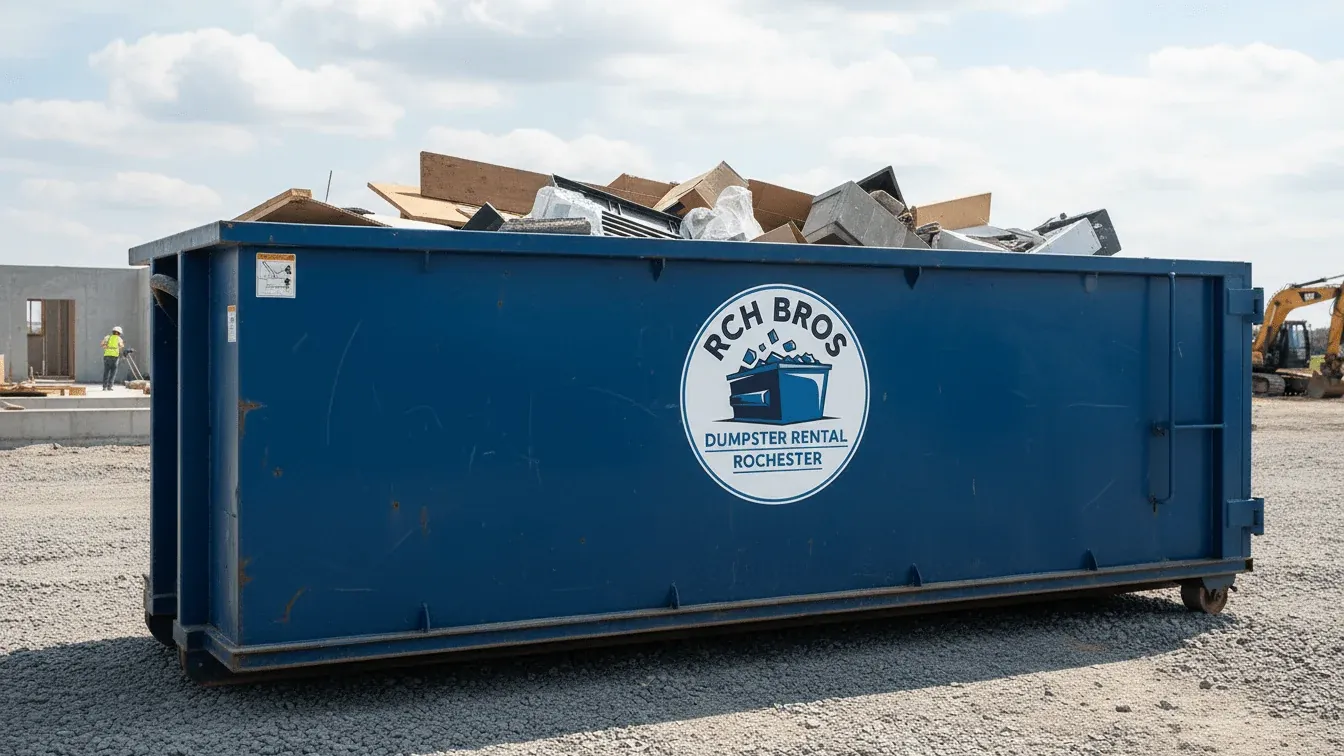
Roll-Off
Roll-Off Dumpster Rental in Rochester
Five sizes, delivered across Rochester and Monroe County out of our own yard on the west side. The container comes off the rails onto plywood, set square, with the door where you asked for it.
A roll-off is the container that arrives on a truck, rolls off the rails onto your ground and rolls back on when you are finished. We run five of them: 10, 15, 20, 30 and 40 yard. The 10 is the weight box — concrete, brick, plaster and lath, rubble foundation spoil. The 15 is one bounded job, a single room or one unit of a two-family turnover. The 20 is the Rochester default, because a full basement and attic clear-out is the Rochester default job. The 30 is a whole two-family emptied, or a large remodel. The 40 is airy bulk only. Everything else on this page is detail hanging off those five sentences, and the full dimensions are on the container sizes page. If you would rather not read any of it, call the yard, describe the pile, and we will tell you which container the material wants.
The thing that decides whether a container can be set is the approach, and in Rochester the approach is more often blocked overhead than on the ground. We want roughly 60 feet of straight run for the truck to line up and back, about ten and a half feet of working width, and 20 feet or more of vertical clearance so the hoist can stand the container up as it comes off the rails. That last figure is the one that fails. This city has a mature street canopy, particularly in Park Avenue, the South Wedge, Browncroft, Corn Hill and the older parts of Brighton and Irondequoit, and running underneath it from the pole to the house is the electrical service drop. A truck can drive under a wire it cannot lift a container under. Walk out to the curb, look up, and tell us what is over the set point. A photograph from the street is even better and takes thirty seconds.
Ground conditions here are their own conversation. Monroe County sits on glacial till and lacustrine silt, and the dominant driveway soils are silt loams — Collamer, which is moderately well drained, and Niagara, which is somewhat poorly drained. Neither of those is expansive clay and neither of them is a desert caliche. What they are is wet in spring. A loaded 20 yard puts several tons on a small footprint, and in March and April, when frost is coming out of the ground, an asphalt driveway over those soils is at its softest of the year. That is why we lay plywood under every wheel and under the rails on every driveway placement, and why we photograph the approach on arrival. It is also why a March delivery sometimes gets a different plan from the same delivery in July. The reasoning is set out in driveway protection.
Where the container sits decides whether you need a permit. A container placed entirely on your own driveway or private property is generally outside the City’s right-of-way permit requirement under City Code § 104-24. If any part of the container or its placement touches the sidewalk, the tree lawn or the street, you need a permit in writing from the City Engineer. Section 104-24(A) is explicit that no person shall place or suffer to remain materials of any kind in the right-of-way without a permit in writing from the City Engineer, except while actively loading or unloading. Section 104-24(C) requires the obstruction to be enclosed with barriers and lit at night. On a Rochester street in December, sunset is before five o’clock, so that lighting requirement is a real one and we put reflective marking on every street placement. Contact the Department of Environmental Services for current fees. Our permit guide walks through it.
Rochester’s on-street environment is unusually restrictive in general. The City limits any vehicle to 12 hours in one spot under § 111-16, and under § 111-73(A), when the Commissioner of Environmental Services advises that plowing will be prevented by parked vehicles, the Mayor may declare an emergency and prohibit parking along designated snow routes, publicised by announcement over not less than two radio or television stations. A container in the street is governed separately, by the right-of-way obstruction permit at § 104-24 with its own conditions and time limit. Out in the towns, most of Monroe County bans overnight on-street parking through the winter, with the months and the hours differing town by town. All of which is a long way of saying the same thing: we would rather put the container on your driveway and bring the plywood. See where we run for the towns we cover.
The Five Sizes And What Each One Is For
10 Yard: The Weight Box
Concrete, brick, block, mortar, plaster and lath out of a pre-1940 wall, rubble foundation spoil and wet basement contents. Reaches a legal payload long before it looks full, which is the container working correctly.
15 Yard: One Bounded Job
A kitchen, a bath, a bedroom stripped to the studs, a garage cleared, a small tear-off, or one unit of a two-family turned over between tenants. A job you can see the end of from the start.
20 Yard: The Rochester Default
A full basement and attic clear-out, a medium remodel, a substantial roof. The size most households here land on, because it matches the most common job in the city.
30 Yard: The Whole Building
A whole two-family turnover with the basement and attic included, a large remodel, a retail refit or a standing contractor container on a job site.
40 Yard: Airy Bulk Only
Whole-house cleanouts, commercial gut jobs, partitions, ceiling grid, systems furniture, cabinetry and framing. No masonry, no soil and no wet material, ever.
Driveway Placements
The default and the one we prefer. Plywood under every wheel and under the rails, set square, door where you asked for it, five feet clear of the siding and the eave line.
Street Placements
Possible, and sometimes the only option on a narrow city lot. It needs a written right-of-way permit from the City Engineer under § 104-24, barricaded and lit after dark under § 104-24(C).
Swaps And Multi-Container Jobs
Two containers loaded by material beat one loaded by convenience. A small box for the heavy debris and a large one for the bulk, swapped as the job moves.
Choosing Between Two Sizes
When you are honestly between two sizes, the question is what the material is made of. If the load is dense — masonry, plaster, tile in a mortar bed, soil, wet contents — take the smaller container and plan a swap, because the larger one will reach payload while it still looks empty and then it cannot lawfully leave your driveway. If the load is bulky and light — furniture, cabinetry, framing, partitions, packaging — take the larger one, because you are paying to move air either way and a swap costs more than the extra capacity. The second question is footprint. A 15 is around sixteen feet long and a 20 is around twenty-two, and on a narrow city lot with a porch on one side those six feet decide whether the container goes in at all. Measure the usable ground before you call, or send a photograph from the curb, and we will tell you straight whether it will fit. The sizing guide works through worked examples.
15 Yard Dumpster
A single room, a small tear-off, or one unit of a two-family turnover.
View this size →20yd³20 Yard Dumpster
A full basement and attic clear-out — the Rochester default — or a multi-room remodel.
View this size →30yd³30 Yard Dumpster
A whole two-family turnover with basement and attic, or a large remodel.
View this size →40yd³40 Yard Dumpster
Whole-house cleanouts, commercial gut jobs and redevelopment debris.
View this size →Delivery, Access And What We Bring
Every delivery gets the same routine. The driver walks the approach before backing, sets plywood under the wheels and under the rails, photographs the ground on arrival, and puts the container square with the door on the side you asked for. We want roughly 60 feet of straight approach, about ten and a half feet of width and 20 feet or more of overhead. On placement we hold five feet clear of combustible walls, openings and combustible roof eave lines, under the Fire Code of New York State at 19 NYCRR Part 1225. The size threshold that triggers that rule tightened in the 2025 code cycle, so check the current figure locally; the five feet has not changed and it is what we work to. In winter we ask you to clear the set point of snow where you can, because a container set on packed snow moves when the snow goes. And keep the tarp on. This county averages 102 inches of snow a year, and every inch of it that lands in an open container is weight you pay to haul.
Not sure this is the right service? Describe the job on the phone and we will point you at the right container even if it is a different service page. Call (585) 514-5622.
Get a flat quote
Two minutes on the phone gets you a size, a price and a delivery slot. No forms.
(585) 514-5622Recommended sizes
How it works
Roll-Off Dumpster Rental in four steps
- 1
Call us
Tell us the project, your address and when you want it. Two minutes on the phone and you have a flat price.
- 2
We deliver
Our driver walks the drop, lays protection boards and sets the container exactly where you want it.
- 3
You load it
Take your time within your rental window. Keep it level with the top rail and we handle the rest.
- 4
We haul it
Call or text when you are done. We pull it, sort what can be recovered and dispose of the rest properly.
Roll-Off Dumpster Rental FAQs
How much clearance do you actually need?
Roughly 60 feet of straight approach so the truck can line up and back, about ten and a half feet of working width, and 20 feet or more of overhead clearance for the hoist. In Rochester the overhead is what stops sets, not the ground. The street canopy over the tree lawn is mature in most of the older neighborhoods and the electrical service drop runs beneath it. A truck will happily drive under a wire that the hoist cannot work under. The other frequent obstruction is a low garage overhang or a carport at the top of the drive. Take a photograph from the curb looking up the driveway and send it to us, and we will tell you whether the set will work before anybody wastes a morning.
Can the container go in the street?
Yes, with a permit. City Code § 104-24(A) provides that no person shall place or suffer to remain materials of any kind in the right-of-way without a permit in writing from the City Engineer, except while actively loading or unloading. The permit carries its own conditions and timeframe, it can be revoked without notice under § 104-24(B), everything has to be removed by expiry under § 104-24(D), and under § 104-24(C) the obstruction must be barricaded and lit at night. Contact the Department of Environmental Services for current fees. Note that this is a public works permit, not a fire permit, and it is issued by the City Engineer. We put reflective marking on every street set.
Will the container damage my driveway?
Not if it is placed properly, and that is our job rather than yours. We lay plywood under every wheel and under the rails on every driveway placement, and we photograph the ground on arrival. The risk here is seasonal. Monroe County’s dominant driveway soils are silt loams that hold water, and in March and April, when the frost is coming out, an asphalt drive over them is at its softest. That is when several tons on four small contact points can take an impression. If your drive is newly sealed, freshly poured or already cracking, tell us at booking and we will talk through where the container should go, including a lawn-edge or street option.
How long can I keep it?
As long as the job honestly needs. Call the yard on (585) 514-5622 when you want it collected and we will fit it into the route rather than hold you to a fixed day. Two things are worth watching. Weight: keep the load below the fill line and load dense material flat on the floor rather than heaped at the door end. And weather: a container standing open in a Rochester winter collects snow roughly every other day in January, and a tarped container is a lighter container. If the box is in the street under a right-of-way permit, that permit has a time limit set by the City Engineer, so a street set is worth finishing promptly.
Do you cover the whole county?
We run out of the west side and cover the city and Monroe County, which means Greece, Irondequoit, Brighton, Henrietta, Gates, Chili, Penfield, Webster, Pittsford and Fairport along with all the city neighborhoods. Gates is our own side of town, so those go out first most mornings. What varies by season is the far east of the county, because the lake-effect gradient off Lake Ontario is real: roughly 70 inches of snow a year south of the city, about 90 in the city itself and over 120 along the lakeshore to the east. On a bad January morning that is the difference between a normal route and a dug-out one. See where we run for the full list.
More services
Other things we haul
Residential Dumpster Rental
Driveway placement for the full-basement, attic and porch cleanouts a pre-1940 house produces.
Learn more →Commercial Dumpster Rental
Containers for businesses and contractors — City Code §20-15F puts construction waste on you, not the City.
Learn more →Construction Dumpster Rental
Mixed C&D in one roll-off, with next-day swap-outs across Monroe County.
Learn more →Roofing Dumpster Rental
Weight-rated cans sized by squares and layers, set five feet off the eave line.
Learn more →Same-Day Dumpster Rental
Call before the cut-off and we can usually get a container to you this afternoon.
Learn more →Junk Removal Dumpsters
Clear a full basement, attic, porch or garage on your own schedule.
Learn more →Estate Cleanout Dumpsters
Discreet, patient container service for families clearing a lifelong home.
Learn more →Demolition Debris Removal
Containers and fast swaps for porches, decks, sheds, garages and interior gut-outs.
Learn more →Concrete & Heavy Debris
Dedicated heavy cans for concrete, brick, plaster and rubble foundation spoil.
Learn more →Yard Waste & Brush Removal
Separate clean loads — the City picks up leaves, not your deck or your shingles.
Learn more →Where we deliver
Roll-Off Dumpster Rental across Monroe County and Greater Rochester
Same service, same flat rates, every town below. Pick yours for local placement and permit notes.
Talk to a real person
Need roll-off dumpster rental in Rochester?
Tell us what you are clearing out and we will tell you the right size and the flat price to put it in your driveway. No forms, no waiting on an email — just call and we will sort it out in a couple of minutes.
Serving Rochester, Monroe County and Greater Rochester · Mon–Fri 6:30am–5pm, Sat 7am–1pm