Construction
Construction Debris Disposal in New York: Rochester Rules
Construction debris in New York is four problems stacked. Here is the order to solve them in a Rochester building, and the three dates that decide what your job really is.
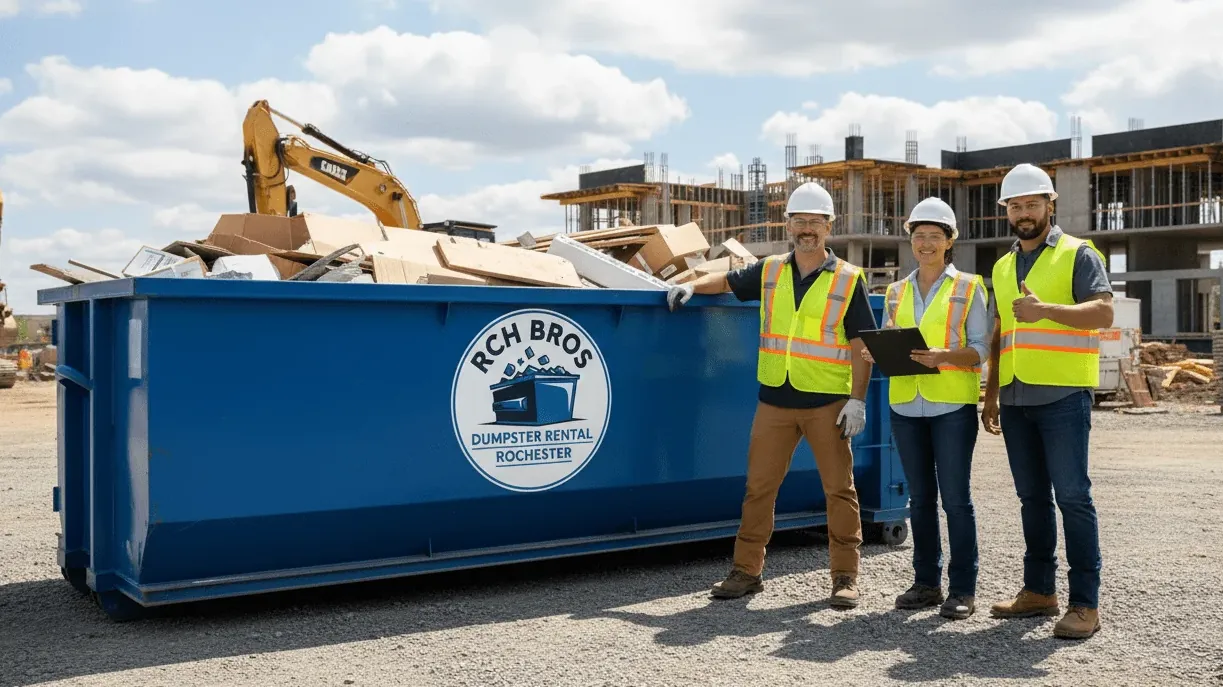
Construction debris in New York is not one problem. It is four, stacked: what the City will and will not collect, what the age of the building triggers, what has to come out before demolition starts, and what can legally ride in a container. Get them in the wrong order and a two-week job turns into a two-month one.
Rochester tightens all four, because Rochester is old. More than half of the city’s housing units were built before 1940, and roughly nine houses in ten predate 1980. Asbestos rules, EPA lead-safe work practices and New York’s new Lead Rental Registry are not edge cases here. They are the default condition of the job.
The City is not going to take it
Start with the sentence that settles the argument. City of Rochester Municipal Code § 20-15F:
“Contractors performing work must make arrangements for the proper and legal collection and disposal of waste generated during the construction process and such waste shall not be collected by the City.”
That is the City telling you outright that construction waste is not on its route. The City-issued refuse container under § 20-12A is for household refuse. The set-out rules at § 20-15B are for household refuse. None of it covers plaster, lath, framing, shingles, cabinets or flooring.
The follow-up question is always whether you can haul it yourself. In Monroe County, usually not. Mill Seat Landfill in the Town of Riga is County-owned and posted as commercial accounts only, no residential customers. A homeowner with a pickup full of plaster has nowhere to take it. The Monroe County ecopark on Avion Drive is excellent for hazardous waste, electronics, appliances and scrap metal, but it is not a construction debris facility.
So the container is not a convenience on a Rochester construction job. It is the disposal route.
Three dates decide what your job actually is
Before you order anything, find out when the building went up. In this market the year of original construction determines which rule sets apply, and three years matter more than any others.
| Year | Rule | What it means in Rochester |
|---|---|---|
| 1974 | 12 NYCRR § 56-5.1 survey exemption | Only buildings whose original construction commenced after 1 January 1974 are exempt from the asbestos survey requirement. Most of Rochester is older. |
| 1978 | EPA RRP Rule, 40 CFR Part 745 | Applies to pre-1978 housing. Window replacement and demolition are always covered regardless of square footage. |
| 1980 | NYS Lead Rental Registry, Public Health Law § 1377 | Covers rental properties with two or more units built before 1980. Rochester is one of 25 named communities of concern. |
Why 1974 is the hinge
Nearly every building in the city predates it. That means the asbestos survey requirement is live on nearly every renovation and demolition inside the city line, and on a very large share of the older suburban stock as well.
Why 1978 catches almost every window job
The EPA’s Renovation, Repair and Painting rule normally has square-footage floors. Two activities do not: window replacement and demolition are always covered, at any size, in pre-1978 housing. In Rochester, that makes a window job essentially always an RRP job. If you are pulling sash out of a 1920s two-family, you are working lead-safe whether you planned to or not.
Why 1980 changed the landlord math
The New York State Lead Rental Registry under Public Health Law § 1377 took effect 3 November 2025, with recertification every three years beginning in 2026, and it applies to rental properties of two or more units built before 1980 in 25 designated communities of concern. Rochester is named. In a city where only 38.1 percent of housing units are owner-occupied, that is not a niche rule. It is the operating condition for most of the residential rehab work in town.
Asbestos: the survey rule, and the trap inside it
New York regulates asbestos through an unusual instrument. The rule is 12 NYCRR Part 56, Industrial Code Rule 56, and it is administered by the New York State Department of Labor, not by an environmental agency. It has been in effect since 21 March 2007. Knowing that it is an Industrial Code Rule tells you which office to call and why the framing is about worker protection.
Who has to do a survey
Section 56-5.1 requires an asbestos survey before demolition, renovation, remodeling or repair. The carve-out, quoted exactly, applies to “an owner or an owner’s agent, except the owner of one and two-family dwellings who contracts for, but does not direct or control the work.”
Read the whole clause. It covers an owner who hires a contractor and genuinely stays out of the work. It is not a general exemption for houses, and anyone who tells you single-family homes are exempt from New York asbestos rules is giving you dangerous advice. An owner who is directing the work, swinging a bar on weekends, or acting as their own general contractor is not inside that carve-out.
The survey exemptions at § 56-5.1(b) are narrow: agricultural buildings, structures whose original construction commenced after 1 January 1974, and buildings certified structurally unsound by a licensed professional engineer, registered architect or building inspector.
An exemption is a presumption, not a pass
This is the part that costs people money, and NYSDOL states it plainly: buildings qualifying for exemptions must still be assumed to contain asbestos and demolished as an asbestos project unless there is a survey that appropriately documents that there is no asbestos.
Turn that around. Skipping the survey does not remove the asbestos rules from your job. It puts you into the asbestos rules by default, as if the material were present, which is the more expensive path. The survey is usually the cheap end of the decision.
The project size tiers
New York sets its own tiers at § 56-2.1, and asbestos-containing material means greater than one percent asbestos.
- Minor: 10 square feet or less, or 25 linear feet or less.
- Small: more than 10 and less than 160 square feet, or more than 25 and less than 260 linear feet.
- Large: 160 square feet or more, or 260 linear feet or more.
Those are New York numbers. Do not substitute a federal figure you found somewhere else.
What it looks like in a Rochester house
The pre-1974 stock here is full of two things in particular: 9 × 9 vinyl asbestos floor tile, usually in a kitchen, a back hall or a finished basement, often under a later layer of sheet vinyl, and asbestos pipe insulation wrapped around the heating lines in the basement. NYSDOL maintains a named Applicable Variance covering floor covering removal and floor tile cleanup, which tells you how routine this material is in the state’s older housing.
If you are opening a basement ceiling or pulling flooring in a pre-1974 Rochester house, assume you will find one or both until a survey says otherwise.
Why asbestos never rides in our container
We do not accept asbestos in our containers. That is a permitting reality, not a preference.
Waste transporters in New York operate under 6 NYCRR Part 364, and asbestos is a Part 364 permit category, the higher tier, not the registration tier. Asbestos in New York moves under that separate NYSDEC permit and must be handled by a NYSDOL-licensed asbestos contractor under 12 NYCRR Part 56. Different truck, different license, different paperwork the whole way to the disposal cell.
Mill Seat does accept special waste including asbestos through commercial channels, but getting it there is the licensed abatement contractor’s job, not ours and not yours. Sequence the abatement first, then bring the container in for everything that is left. Our demolition debris page walks through that order.
Lead-safe work is the baseline here
Rochester has regulated lead paint since well before the state did. City Municipal Code Chapter 90, Article III, enacted in 2005 and effective July 2006, ties lead inspection into the Certificate of Occupancy process. Buildings with three or more rental units are inspected every three years; one and two unit buildings every six, or every three in a designated high-risk area with prior violations.
The distinctive piece is the geography. The Mayor designates a Lead Paint High-Risk Area, and inside it a property that passes visual inspection must also pass dust wipe testing even with no visible deterioration. Outside it, dust testing is triggered by violations. Section 90-54 sets the violation thresholds at deteriorated paint exceeding 20 square feet on the exterior or 2 square feet per interior room.
It worked. Between 2006 and 2020 the City inspected 193,584 rental units, with 50,901 units in high-risk areas receiving dust wipe inspections, and elevated blood lead levels in Monroe County fell from 13.4 to 1.1 children per 100 tested between 1997 and 2011, a decline substantially steeper than the statewide trend.
For your debris, the practical consequences are containment and sequencing rather than a separate disposal stream. Plastic down, debris bagged at the work area, container close enough that you are not carrying open material across a yard. The EPA publishes the RRP work practices, and the New York State Department of Health handles the Lead Rental Registry side. We cover the debris handling specifically in lead-safe renovation debris.
The pre-demolition sweep
Before the walls come down, a short list of things has to come out of the building. None of them can go in a container.
- Mercury thermostats. Disposal banned since 2005, and NYSDEC states specifically that contractors demolishing buildings are required to bring mercury thermostats to collection programs. Old round wall thermostats are still common in this housing stock.
- Electronics. Banned from landfill, trash and curbside since 1 January 2015.
- Rechargeable batteries, including e-bike and e-scooter packs after a 2025 amendment. These are also a fire risk in a loaded box.
- Waste tires. Land burial prohibited. Garages and barns are full of them.
- Paint, solvents, fuel and pool chemicals. PaintCare has run in New York since May 2022, and the ecopark takes household hazardous waste by appointment.
- Fluorescent tubes and ballasts. Ecopark, walk-in.
What goes in the box, and which box
Once the sweep is done and any abatement is finished, most construction debris is straightforward container material: framing, plaster, lath, subfloor, roofing, siding, windows, doors, cabinets, fixtures, carpet, drywall and general jobsite waste.
The sizing rule on a construction job is different from a cleanout. Dense material means a smaller box and more swaps. Plaster and lath is the classic case, and it is the single most common reason a Rochester container goes over payload while it still looks half full. Masonry, spoil from a rubble foundation repair and concrete belong alone in a 10 yard. Bulky mixed demolition goes in a 20 or a 30. Our sizing guide has the breakdown, and the construction dumpster page covers scheduling on an active site.
Placement on an active jobsite
Two site rules apply no matter the scale. First, fire clearance: New York’s fire code, the Fire Code of New York State at 19 NYCRR Part 1225, carries the International Fire Code rule that a container over the size threshold may not sit inside a building or within five feet of combustible walls, openings or combustible roof eave lines. The threshold tightened in the 2025 code cycle, so check with your local code enforcement officer. We keep every container five feet off the siding, the soffit line and any opening.
Second, if the container goes in the street rather than on the lot, that is a written right-of-way permit from the City Engineer under City Code § 104-24, and § 104-24(C) requires the obstruction to be barricaded and lit at night. On a Rochester street in December, sunset is before five o’clock. Plan the marking, not just the permit.
The bigger picture in this market
Rochester spent three years filling in a sunken expressway on the east side of downtown, a project that closed the road in December 2014 and finished in November 2017, converting the freeway into an at-grade street and creating roughly six acres of shovel-ready sites. The Inner Loop North Transformation was approved for federal funding in January 2025 with a 100 million dollar federal grant through the Reconnecting Communities Pilot Program, removing the segment between I-490 and North Union Street and opening up roughly 22 more acres, with construction expected to begin in 2027. Every acre of that is demolition, excavation and construction debris, in a corridor lined with exactly the pre-1974 building stock this article is about.
Sequence it once and it runs clean
Find the build year. Get the survey if the building predates 1974. Handle abatement first, under license, on its own paperwork. Run the pre-demolition sweep for thermostats, electronics, batteries, tires and chemicals. Then bring in the container and load everything that is left, sized for weight rather than for how the pile looks.
We have been running construction cans out of the west side since 2011 and we know what comes out of these buildings. Call (585) 514-5622 with the address and the build year and we will get the box right the first time.
Questions this guide did not answer? Call (585) 514-5622. We would rather spend two minutes on the phone than have you order the wrong container.